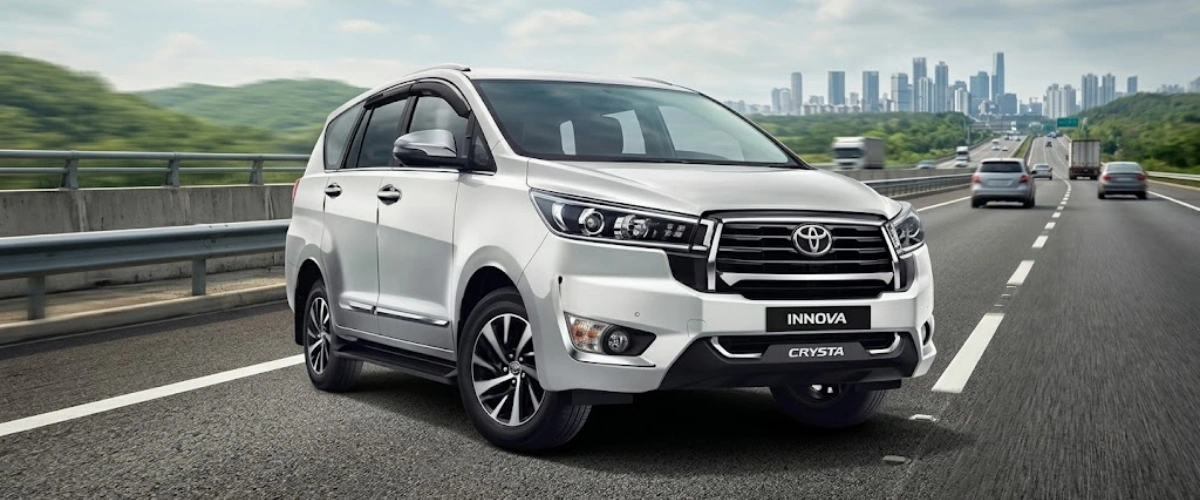
Twenty years. Over 12 lakh units sold. A nameplate so deeply embedded in India's automotive DNA that it functions almost as a cultural institution, seen in school convoys, pilgrim trips, hill-station holidays, political motorcades, and premium cab fleets simultaneously. The Toyota Innova Crysta has done something very few vehicles manage: it has remained genuinely desirable for two decades without ever going through an identity crisis.
Now in June 2026, Toyota has refreshed the Crysta with updated styling, new interior touches, and added features — revised prices starting at Rs 19.72 lakh — keeping it firmly relevant in an MPV segment that has grown both more competitive and more technologically demanding. This is a complete look at what the 2026 Innova Crysta offers, where it excels, and where it still makes compromises.
What's New in the 2026 Update
Toyota hasn't reinvented the Crysta — and that's a deliberate call, not laziness. The 2026 edition comes with a bold new grille and updated front and rear bumpers, dual-tone leather seats, updated interior trim, copper bezels, and wood pattern highlights. Toyota has also added new features such as a wireless charger and TPMS.
The key word here is "refresh." This is not a ground-up redesign but a meaningful update that addresses real-world feedback while preserving the platform and mechanicals that have made the Crysta bulletproof over the years. Copper bezels and wood-pattern highlights may sound like minor additions on paper, but they noticeably elevate the interior ambience in a cabin that many buyers spend hours in daily.
Exterior Design: Commanding and Purposeful
Front Profile
The 2026 Crysta wears a more assertive face. The bold chrome front grille gives it a stronger visual presence on the road, and the LED projector headlamps sharpen the overall look without going ostentatious. The redesigned front bumper adds a sense of width and planted confidence that suits a vehicle of this stature.
This isn't a car trying to look youthful or sporty — it's a vehicle that communicates authority, durability, and purpose. For its core buyer — families, executives, and fleet operators — this is exactly the right visual language.
Side and Rear
The Crysta retains the familiar MPV silhouette with a muscular and premium appearance. Strong character lines run along the sides, and the five colour options for 2026 — Platinum White Pearl, Super White, Silver Metallic, Attitude Black Mica, and Avant-Garde Bronze Metallic — give buyers enough choice to personalise without going garish. The Bronze Metallic option is new and particularly striking for those wanting something a little more distinctive.
Interior: Where the Crysta Has Always Won
Cabin Quality and Ambience
Step inside the 2026 Crysta and the updated interior treatment is immediately apparent. The Innova Crysta interior features black and beige dual-tone styling with soft-touch surfaces on the dashboard and door panels. The copper bezels and wood-pattern inserts added in the 2026 update lend a more premium visual warmth to what was already one of the more substantial-feeling cabins in its segment.
The door-closing thud that Crysta owners have referenced for years is very much still here. The overall build solidity — the way panels align, the way materials resist flexing — this is what sets the Crysta apart from many nominally-priced rivals. It feels like it's built to last fifteen years, because it is.
Seating: The Crysta's Crown Jewel
The cabin offers captain seats with slide and recline function, soft-touch materials, ambient lighting, and automatic climate control for enhanced comfort. The second-row captain seats in the 7-seater configuration are genuinely comfortable for long journeys — wide, well-padded, with enough travel on the slide to accommodate both short and tall passengers. Third-row access is reasonable by MPV standards, and third-row occupants get more legroom than most rivals in this segment offer.
The 7-seater captain seat configuration versus the 8-seater bench configuration is a real decision point for buyers. Families who travel frequently should strongly consider the 7-seater — the second-row captain seats transform long-distance travel quality meaningfully.
Engine and Performance: The 2.4L Diesel That Refuses to Age
Specifications
The Innova Crysta continues to be powered by a 2.4-litre diesel engine, which produces 148 BHP and 343 Nm of torque, mated to a 5-speed manual gearbox. This engine has been in production for years and its longevity is a testament to how well-engineered it is. It's not the most powerful diesel in its class on paper, but the 343 Nm of torque is what matters in real-world Indian driving — overtaking on highways, climbing ghats fully loaded, or crawling through city traffic with air conditioning running at full blast.
Real-World Performance and Mileage
The Toyota Innova Crysta mileage is 15.6 kmpl as per ARAI certification. In the real world, across mixed city and highway use, most owners report figures in the 12–14 kmpl range — consistent with what a full-sized diesel MPV of this weight class can realistically deliver. Real-world performance clocks in at 13–14 kmpl, which for a vehicle weighing over 1,800 kg and comfortably seating seven people is actually respectable.
The engine note is distinctive — it has a diesel clatter at idle that settles into a composed hum at cruising speeds. Noise insulation in the cabin is good enough that it doesn't intrude on conversation, though it's not as hushed as hybrid powertrains.
Driving Dynamics
The Crysta offers strong low-end torque and long-distance comfort. This is fundamentally a rear-wheel-drive MPV on a ladder-frame platform, and that translates into a predictable, stable highway character that body-on-frame enthusiasts swear by. The ride absorbs bad road surfaces with composure — important on Indian highways and rural roads that can vary dramatically in quality within a single journey. The steering is accurate without being sporty; this is a vehicle tuned for comfort and confidence, not handling agility.
Manual Only — A Real Limitation
One of the 2026 Crysta's most discussed limitations is that it is available only with a 5-speed manual gearbox. There is no automatic transmission option. The car currently comes in only one form: a 2.4-litre diesel engine and manual gearbox. For buyers who spend significant time in city traffic — particularly in metros like Mumbai, Delhi, or Bengaluru — the absence of an automatic is a genuine inconvenience. This is arguably the single biggest practical limitation of the current Crysta, and it's worth being honest about. If you need an automatic MPV, you're looking at either the Innova Hycross or a different segment entirely.
Features: What You Get Across Variants
Variants and Pricing
The Toyota Innova Crysta is available in 4 trims — GX, GX+, VX, and ZX — with prices ranging from Rs 18.09 lakh to Rs 26.86 lakh ex-showroom. The 2026 update revises the starting price to Rs 19.72 lakh. Both 7-seat and 8-seat configurations are available across trims, giving buyers genuine flexibility depending on how they use the vehicle.
Technology and Connectivity
Features include a touchscreen infotainment system with smartphone connectivity, steering-mounted controls, and — new for 2026 — a wireless charger and TPMS. Android Auto and Apple CarPlay connectivity keeps the infotainment system relevant even if the screen itself isn't the largest available in the segment.
The TPMS addition is practically useful rather than just spec-sheet padding — for a vehicle frequently used on long intercity journeys, knowing your tyre pressure in real time reduces the risk of blowouts on highways where roadside assistance can be far away.
Comfort and Convenience
The ZX trims feature leather upholstery, an 8-way powered driver's seat, and ambient lighting, while Toyota's safety suite includes seven airbags, front and rear parking sensors, Vehicle Stability Control (VSC), and Hill-Start Assist. The ambient lighting addition is subtle but effective at night — it transforms the cabin atmosphere considerably.
Automatic climate control, which the Crysta has long offered, continues to be well-implemented. For a 7-8 passenger vehicle, the ability to maintain consistent cabin temperature across all three rows matters on long drives, and the Crysta handles this reliably.
Safety: Solid but Not Class-Leading in Specifications
Key safety features include 7 airbags — protection for the driver, passenger, sides, and a knee airbag for the driver — VSC to keep the car stable during sharp turns, Hill Start Assist to prevent rolling back on slopes, and Brake Assist for extra stopping power in emergencies.
Seven airbags is a strong safety specification for a vehicle at this price point. The VSC is particularly important on a rear-wheel-drive platform — it intervenes during oversteer situations that can catch inexperienced drivers off guard on wet roads or sudden lane changes. The "GOA" body structure that Toyota uses is engineered to manage impact absorption intelligently, and the Crysta's real-world accident survivability record is strong.
What the 2026 Crysta still doesn't offer: ADAS features like lane-keep assist, automatic emergency braking, or adaptive cruise control. These are increasingly available on similarly-priced competitors. Toyota has kept the safety suite functional and proven rather than adding features purely for spec comparison, which is a valid engineering choice — but buyers comparing feature lists should note this gap.
Ownership Cost and Long-Term Reliability
This is where the Crysta's case becomes almost unassailable. Toyota's service network is legendary. Even in a remote village in India, you can find a mechanic who knows how to fix an Innova. The scheduled service cost is very predictable, and Toyota also offers excellent extended warranty plans up to 7 years.
The 2.4L diesel engine has been in production long enough that its maintenance requirements are well understood by every Toyota service centre across India. There are no surprises, no complex electronics-dependent repair bills, no waiting for rare parts. Diesel engine overhauls at 2–3 lakh kilometres are a known quantity. For fleet operators, this predictability is not just convenient — it's financially significant.
Running costs on diesel are reasonable over long distances. At real-world efficiency of 12–14 kmpl and diesel prices where they currently are, the Crysta is meaningfully cheaper per kilometre than petrol alternatives of comparable size.
The Crysta vs the Hycross: Which Toyota MPV Should You Buy?
Toyota now sells two Innovas simultaneously, and the question of which one to buy is increasingly common. The Innova Hycross starts at a similar price point but uses a hybrid petrol powertrain, offers an automatic gearbox, and has a more modern feature set.
The Crysta is for buyers who: prioritise diesel economy on long runs, need rear-wheel-drive toughness for rough roads, value proven-over-decades mechanical reliability, or operate in areas where CNG or hybrid service infrastructure is thin.
The Hycross is for buyers who: want an automatic transmission, live primarily in urban environments where the hybrid system's regeneration benefits are maximised, or prioritise modern technology and feature depth over mechanical simplicity.
Both are excellent MPVs. They serve genuinely different use cases.
Who Should Buy the 2026 Innova Crysta?
The 2026 Crysta makes the most sense for large families who do regular long-distance travel, particularly on highways and semi-urban roads. It's also the default choice for anyone operating in the premium cab or tour operator segment — the combination of reliability, low running cost, and passenger comfort makes it commercially viable in a way that depreciation-heavy alternatives aren't.
For pure city use — with stop-and-go traffic daily — the lack of an automatic gearbox is a real quality-of-life compromise. For those buyers, the Hycross is a more sensible daily tool.
Final Verdict: Twenty Years In, Still Irreplaceable
The 2026 Toyota Innova Crysta doesn't try to be everything to everyone. Even after so many years, the Innova Crysta has no direct competitor that offers the same mix of space, comfort, and reliability. The 2026 update — new grille, copper bezels, dual-tone leather, wireless charging, TPMS — is not a radical overhaul, but it sharpens an already-strong proposition.
What you're buying with the Crysta is not the most feature-laden MPV in the segment. You're buying the most dependable one. You're buying a vehicle that will start every morning in every weather, absorb every road surface without complaint, carry seven people in genuine comfort, and still be running reliably a decade from now. At a time when hybrids buzz everywhere, the Crysta's diesel stalwart character holds up — absolutely, if you value torque over tech hype.
For everything else there's the Hycross. For the Innova experience that millions of Indian families have trusted for twenty years — there's still only one answer.

Rohit Sharma
AuthorLast updated 6 hours ago