There is a particular kind of car buyer in India in 2026 who is impossible to satisfy with a single-paragraph answer. This buyer has crossed the ₹70 lakh threshold, has decided they want a six-cylinder engine, wants all-wheel drive, wants something that moves with genuine urgency, and — critically — wants a car they can live with every single day on Indian roads, in Indian traffic, with Indian weather, and under Indian ownership conditions.
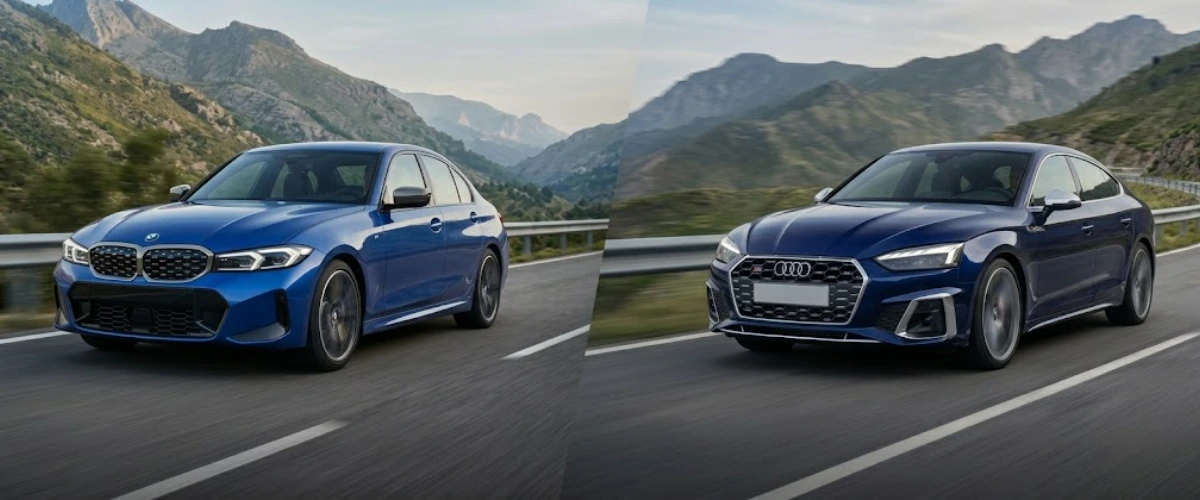
That buyer is standing in front of two cars that, on paper, look almost identical in specification and price. The BMW M340i xDrive and the Audi S5 Sportback are both six-cylinder turbocharged petrol machines producing around 350–374 hp, both equipped with AWD, both electronically limited to 250 km/h, both priced between ₹72 and ₹75 lakh ex-showroom. The brochures make both cars sound like the definitive answer.
They are not the same car. Not even close.
This blog is about everything the brochures, press releases, and launch events won't tell you — the character differences, the real-world India context, the ownership cost realities, the resale dynamics, and the deeply personal question of which one actually suits the life you lead.
Setting the Stage: Where Each Car Comes From
Understanding the DNA of each car is essential before comparing them, because their engineering philosophies are fundamentally different.
The BMW M340i is a sports sedan first. It is the M Performance derivative of the BMW 3 Series — BMW's most sacred nameplate, the one the company has built its entire handling reputation on since 1975. BMW India confirmed that the M340i has stood as the highest-selling performance car in the Indian market for over three consecutive years, with more than 1,000 customers in the country. The M340i is not built to be the most comfortable or most practical car in its class. It is built to be the most involving performance car that is still physically capable of being your daily driver.
The M340i is locally produced at BMW Group Plant Chennai — a fact that has enormous implications for pricing, and one that the Audi camp simply cannot match.
The Audi S5 Sportback occupies a different philosophical position. It is the S-badged, high-performance version of the A5 Sportback — a five-door grand tourer in coupe clothing. The S5 Sportback is where business-class refinement meets proper performance muscle. It delivers V6 power, quattro all-wheel-drive grip, and the versatility of a five-door Sportback body. Where the M340i prioritises sharpness and driver engagement above all else, the S5 Sportback prioritises the seamless integration of performance and premium everyday usability. It is built for someone who wants to be fast and comfortable simultaneously, without making any compromises that require an apology.
These two philosophies — raw engagement versus refined composure — run through every single dimension of this comparison.
2. The Engine Battle: Inline-Six vs V6
Both cars use a 3.0-litre six-cylinder turbocharged petrol engine. Beyond those facts, the similarities end.
BMW M340i — The B58 Inline-Six:
The M340i is powered by a 2,998cc straight-six petrol engine producing 374 hp and 500 Nm of maximum torque, paired with an eight-speed Steptronic Sport automatic transmission. The B58 engine is one of the most celebrated modern six-cylinder units in the world — widely regarded among automotive engineers and tuners as perhaps the greatest naturally tuneable inline-six in production today. It is a 48V mild-hybrid system-equipped unit in the latest iteration, and it completes the 0-100 km/h sprint in 4.4 seconds, making it the quickest BMW to be produced in India and the quickest ICE-powered car to be built in the country.
Audi S5 Sportback — The 3.0 TFSI V6:
The S5 Sportback is powered by a 3.0-litre turbocharged V6 producing 354 hp and 500 Nm of torque, paired with an 8-speed torque-converter automatic gearbox and quattro AWD. The 0-100 km/h sprint takes 4.8 seconds.
The V6 TFSI's character is utterly different from the BMW's B58. Power delivery is smooth and linear rather than explosive. The Hot-V turbo layout reduces lag, making the throttle response feel immediate and strong throughout the rev band. Where the BMW builds to a frenzied crescendo at high revs, the Audi delivers its performance like a wave — steady, overwhelming, always present.
The raw verdict on engines: The M340i has more power (374 hp vs 354 hp), revs higher, sounds better, and is 0.4 seconds quicker to 100 km/h. The S5's V6 is smoother, more refined, and provides a more relaxed high-speed cruising character. If you want excitement, the BMW wins. If you want effortlessness, the Audi wins.
The Transmission Question: Two Different Philosophies
This is a detail that almost no mainstream review in India addresses adequately, but it is one of the most significant real-world differences between the two cars.
BMW M340i — 8-Speed Steptronic Sport (ZF 8HP):
The M340i uses a modified version of the ZF 8-speed automatic that BMW has tuned specifically for M Performance applications. In Sport mode, it is extraordinarily fast to respond, holds gears aggressively through corners, and delivers sharp, satisfying upshifts under full throttle. The manual paddle shifters on the steering column are among the most responsive in this class.
Audi S5 Sportback — 8-Speed Torque Converter Automatic:
The S5 uses a torque-converter automatic rather than a dual-clutch unit. This gives it a measurably smoother, more relaxed low-speed character — particularly useful in slow city traffic. The BMW's engine and gearbox are better synced than the Audi's — the ZF transmission is smoother, slightly quicker, and more alert in kick-down. But on its own, the S5's drivetrain never misses a beat.
In the Indian context — where city driving involves a great deal of low-speed, stop-start manoeuvring — the S5's torque-converter automatic is genuinely more livable on a daily basis. The BMW's sportier transmission calibration occasionally introduces a slight jerkiness at very low speeds in normal mode, which can feel incongruous in a Bengaluru traffic jam.
Body Style and Design: Sedan vs Four-Door Coupe
This is where the two cars diverge most visibly, and where the choice becomes deeply personal.
The M340i is a three-box sedan. Traditional boot, upright rear windscreen, conventional proportions. It is handsome and athletic — the sharp creases and lines denote the rush of speed, and the M340i largely blends into traffic unless optioned in a vibrant colour. It is, in the truest sense, a sleeper. Park an Arctic Race Blue M340i next to a regular 3 Series and enthusiasts will notice immediately. Most others will not.
The front design features elegantly styled LED headlights with an upside-down L arrangement, combined with a distinctive kidney grille in mesh design and large hexagonal air inlets. The M Sport aerodynamics package, M rear spoiler, and broader stance complete a picture that is menacing in a precise, understated way.
The Audi S5 Sportback makes no attempt to blend in. The S5 Sportback's swooping roofline catches attention in traffic. BMW has sharp creases and lines denoting the rush of speed, whereas the Audi S5 has smooth lining contours denoting elegance.
The exterior features S-specific bumpers, a honeycomb grille with aluminium silver inserts, silver ORVMs, quad exhaust tips, and 19-inch S-style alloy wheels. The quad exhaust pipes deserve special mention — four round pipes emerging from the rear diffuser is one of the most visually distinctive signatures in this segment, and it is unmistakably, unambiguously a performance car from 30 metres away.
Dimensions stand at approximately 4,765mm in length, 1,845mm in width, and 1,390mm in height, with a wheelbase of 2,825mm. The S5 is substantially lower than the M340i — 1,390mm compared to the BMW's approximately 1,430mm — which gives it a more planted, wide-bodied presence on the road.
Interior Experience: Sports Cockpit vs Grand Touring Lounge
Step inside both cars and you immediately understand the different intended experiences.
BMW M340i Interior:
The slim, frameless BMW Curved Display seems to hover freely above the instrument panel and, as a touch-capable display unit, offers modern and convenient operability. The centre console provides a sporty and enclosed seating sensation. The driving position is low, snug, and forward-leaning. The M-specific sport seats with bolstering wrap you firmly — excellent when cornering hard, slightly demanding over a two-hour motorway stretch.
The Harman Kardon Surround Sound System features a 464-watt digital amplifier, nine channels, and 16 speakers, with vehicle-specific, speed-dependent equalising.
Audi S5 Sportback Interior:
The interior offers a 10.1-inch touchscreen infotainment system, Audi Virtual Cockpit digital instrument cluster, three-zone climate control, electrically adjustable sports seats with leather and Alcantara upholstery, brushed aluminium trim, ambient lighting, and a flat-bottom S steering wheel.
The S5's cabin is wider and more airy than the M340i's. The rear seats in the S5 are more comfortable than the M340i's — they don't hug you as tightly but provide proper supports for the entire body in a cushiony way. For a car that will occasionally carry two rear-seat passengers on a weekend Goa trip or a business client from the airport, this matters considerably.
Boot Space:
The M340i has a 480-litre boot expandable via 40:20:40 split rear seats. The S5 Sportback boot space stands at around 480 litres, benefiting from the four-door coupe-style Sportback liftback design which improves everyday practicality. Both cars offer near-identical boot volumes, but the S5's liftback tailgate opening — the full rear glass lifts with the tailgate — provides a dramatically larger aperture for loading bulky items. Fitting a pair of golf bags, a set of luggage, or even a folded baby pram is meaningfully easier in the S5 than in the M340i's conventional boot opening.
The Driving Dynamics Difference: The Honest Truth
If you really need a sports sedan for daily runs and as comfortable as a family car, the S5 is the right choice. But if you want sharp dynamics, sheer power, raw feel, and striking elements with a car for weekend runs, the M340i is the one to choose.
That one sentence from a Team-BHP owner comparison captures the essential truth more precisely than any press test.
The M340i on Indian Roads:
The M340i's M Sport suspension, which sits 10mm lower than the standard 3 Series, is calibrated for aggressive driving. On smooth NH-48 tarmac or on the Expressways of Maharashtra, it is sublime — planted, communicative, with a steering rack that gives you genuine feedback from the road surface. In Dynamic mode, it transforms into something that genuinely justifies the word "thrilling."
On potholed city roads in Delhi's residential sectors, Bengaluru's BDA layouts, or Mumbai's Parel industrial lanes, the same firm suspension transmits impacts firmly into the cabin. Run-flat tyres, standard on the M340i, exacerbate this. The M340i on broken urban tarmac can be tiresome on a bad day.
The M340i feels laggy at the bottom end in Eco Pro mode and the throttle is just so dull. It's aggressive because there is a silence-before-the-storm situation — one feels like driving a normal petrol BMW until 3,500–4,100 rpm, but beyond that it becomes a totally mad machine in Sport mode.
The S5 Sportback on Indian Roads:
The S5 Sportback is one of the most usable sports sedans in its class. While others are more powerful with sharper dynamics, the S5 excels in comfort, interior space, luggage capacity, and has decent ground clearance for a low-slung car, while still being powerful and dynamic enough to be enjoyable.
Ground clearance is 117mm, which requires care on steep speed breakers, but handles most road surfaces reasonably well. For a car this low and this performance-focused, 117mm of ground clearance in India is actually competitive with most rival offerings in this bracket.
The Manufacturing Advantage: Why the M340i Costs Less
This is perhaps the most important contextual fact in this entire comparison, and the brochure won't mention it once.
The BMW M340i xDrive is the first M-badged BMW to be locally assembled in India at BMW's Chennai facility, and the BMW does show its benefits in terms of pricing. Local assembly under the CKD (Completely Knocked Down) route means the M340i avoids the punishing 100%+ import duty that India levies on CBU (Completely Built-Up Unit) vehicles. This is the single biggest reason for the price gap between the two cars.
The S5 Sportback's pricing reflects the fact that it is a CBU import. Every unit shipped to India as a fully assembled car is taxed heavily at the border — a structural disadvantage that Audi cannot engineer its way out of without committing to local assembly, which hasn't happened for the S5.
The result: BMW M340i starting price is ₹72.75 lakh in India while Audi S5 Sportback's starting price is ₹73.57 lakh in India. On paper, this is a mere ₹82,000 difference — trivial for cars at this price point. But the comparison is deeply misleading, because the M340i at ₹72.75 lakh is a locally produced car, while the S5 Sportback at ₹73.57 lakh is a fully imported CBU that should, in a world without import duties, cost considerably less. The CBU status means Audi's hands are partially tied on pricing flexibility, while BMW has genuine room to manoeuvre with festive discounts, corporate deals, and bundle offers on the M340i.
Real Pricing: What You Actually Pay in India
BMW M340i: BMW M340i price in India starts at ₹72.75 lakh and goes up to ₹76.40 lakh (ex-showroom) for the top variant. On-road price in Chennai starts at ₹91.42 lakh for the base variant, including RTO charges of approximately ₹14.80 lakh, insurance of ₹3.11 lakh, and TCS of ₹72,750. On-road in Delhi, the number comes in slightly lower due to different state registration norms, typically around ₹84–87 lakh for the base.
Audi S5 Sportback: With the implementation of GST 2.0 in September 2025, the starting price of the Audi S5 Sportback was reduced to ₹73.57 lakh ex-showroom. On-road prices range between ₹84.4 lakh and ₹92.3 lakh depending on variant and city. The Platinum Edition, a limited-run higher-spec variant, was launched at ₹81.57 lakh ex-showroom.
Both cars sit in comparable on-road price territory in most cities. The S5 Sportback is offered as a single fully loaded variant in India — there is no base-spec S5. The M340i offers two variants, giving buyers an entry price point.
Fuel Efficiency: The Number That Will Surprise You
ARAI-claimed mileage of the M340i is 13.02 kmpl while the S5 Sportback's ARAI-claimed figure is 10.6 kmpl. This gap — 2.4 kmpl — is substantial for cars in the same performance bracket.
The reason is the M340i's 48V mild-hybrid system, which assists the engine under light load and during coasting, meaningfully improving efficiency on Indian urban drive cycles. The S5 does not have a mild-hybrid system in its current India-spec configuration.
In real-world Indian driving conditions, the M340i owner can expect 9–10 kmpl in city traffic and 12–13 kmpl on highways. The S5 owner should realistically expect 7–8 kmpl in city driving and 10–11 kmpl on national highways. Over a typical Indian ownership cycle of 15,000 km per year, the fuel cost difference — at ₹102 per litre average petrol pricing — works out to approximately ₹30,000–₹45,000 per year in favour of the M340i.
Over a three-year ownership cycle, this difference compounds to approximately ₹90,000–₹1.35 lakh in additional fuel costs for the S5 Sportback owner. Not a decisive amount at this price level, but a real number worth acknowledging.
Ownership Costs Over Three Years: The Full Picture
This is the section most Indian luxury car buyers wish they'd read before signing the dotted line.
BMW M340i: Being locally assembled, the M340i benefits from a broader parts supply chain, wider service network availability, and generally lower parts costs compared to a CBU import. BMW's service network in India spans over 50 cities — meaningfully more than Audi's currently operational network for S-badged models.
Audi S5 Sportback: As a CBU import, the S5 Sportback faces higher spare parts costs simply because all components are imported. The V6 TFSI engine, while reliable, requires specific Audi-approved oil grades and timing maintenance that is best handled at authorised centres. The S5's suspension components, in particular, can be expensive to replace after a serious pothole encounter — a non-trivial risk in Indian cities.
User reviews of the S5 Sportback consistently highlight that it is more practical than the BMW M340i and feels better value at its price point in terms of the overall package. However, the full cost-of-ownership picture over 36 months — including service, tyres, insurance, and parts — tends to favour the M340i's locally-assembled status.
Tyres: Both cars use 19-inch performance tyres. The M340i runs run-flat tyres as standard, which are typically 30–40% more expensive per set than conventional tyres. The S5 does not use run-flats. Over a typical replacement cycle of 40,000–50,000 km in Indian conditions, this means the M340i owner will spend approximately ₹25,000–₹35,000 more on tyres over three years. Run-flat tyres also provide a harder ride characteristic, which connects back to the comfort discussion.
Resale Value: The Honest Conversation
Both cars depreciate significantly in the Indian luxury car market, but in different patterns.
The BMW M340i, being locally assembled and the segment's highest-selling performance car with an established base of over 1,000 owners in India, has a stronger and more predictable used car market. Buyers searching for used performance sedans are more likely to be familiar with the M340i's value proposition, making resale more liquid.
The Audi S5 Sportback, being a CBU import with limited unit numbers, has a smaller used car pool — which can work both ways. Fewer units in the used market mean less competition among sellers, but also fewer qualified buyers who understand the product. As a rule of thumb, CBU luxury cars depreciate faster in percentage terms than CKD-assembled equivalents in India, particularly if the brand doesn't have a strong enthusiast resale community.
For most Indian buyers planning a three-year ownership cycle, the M340i will return a slightly better residual value percentage. If you're buying the S5 Sportback, plan to hold it for a longer period to amortise the depreciation curve more effectively.
What the Brochure Genuinely Doesn't Tell You
Here are the five things neither company will volunteer in any marketing material:
One — The M340i is genuinely unsatisfying in slow city traffic. Its performance tuning is calibrated for roads that reward it. In Gurugram's Sohna Road traffic at 8:30 AM, the M340i's transmission and suspension feel over-engineered for the task. This is not a flaw in the car; it is a mismatch between the car's purpose and many buyers' daily reality.
Two — The S5 Sportback's ground clearance requires vigilance. At 117mm, the S5 will scrape on steep petrol station ramps, unmarked road dividers in Tier-2 cities, and aggressive speed breakers in residential colonies. This is not a hypothetical concern — multiple S5 owners in India have reported front lip and underbody damage. A set of speed-breaker strips (available for under ₹5,000) and careful approach angles mitigate this, but it requires attention that a taller SUV would never demand.
Three — The M340i's exhaust note will eventually attract unwanted attention. In Sport mode, the M340i is loud enough to generate noise complaints in quiet residential building compounds. If you park underground in a South Mumbai cooperative housing society or a Delhi DLF enclave, your neighbours will know when you arrive home.
Four — The S5 Sportback is approaching end-of-lifecycle in India. The S5 is at the end of its lifecycle, and there may not be many units left to buy. This has two implications: first, unsold inventory may create genuine discount opportunities from dealers in the next six to twelve months; second, parts availability for the current-generation engine and electronics platform will only get more limited over time.
Five — The M340i has enormous tuning potential that its brochure ignores entirely. The B58 engine is universally acknowledged as one of the most tuner-friendly modern platforms in existence. A Stage 1 ECU remap (available at reputable workshops in Mumbai, Delhi, and Bengaluru for approximately ₹40,000–₹60,000) reliably pushes output to 420–430 hp. The S5's V6 is tuneable but considerably less dramatically so — and being a CBU import, any non-standard modification has more significant implications for warranty claims.
Final Verdict: The One Sentence Nobody Wants to Hear
Both cars are outstanding. Neither is wrong. The M340i is the better performance car for the money, the better-supported ownership in India, and the sharper instrument. The S5 Sportback is the more beautiful, more comfortable, more practically versatile grand tourer that remains deeply, genuinely exciting.
The M340i is the clear objective winner of any head-to-head test. But the S5 Sportback is the one that steals your heart.
If that sentence resonates with you, you already know which one to buy.

Rohit Sharma
AuthorLast updated 8 minutes ago