Walk into any car showroom in India, browse any automobile forum online, or ask ten car owners this question, and you'll get ten different opinions — mostly based on half-truths, brand bias, or simply "alloys look better, so alloys are better." The steel vs alloy debate is one of the oldest and most consistently misunderstood in the automobile world.
Here is the truth: neither wheel type is universally better. Each one wins decisively in specific conditions, fails badly in others, and the "right" answer depends entirely on who you are, where you drive, and what you want from your vehicle. This guide cuts through the noise and gives you the complete, technically grounded picture.
First, let's understand what these things actually are.
What Are Steel Rims?
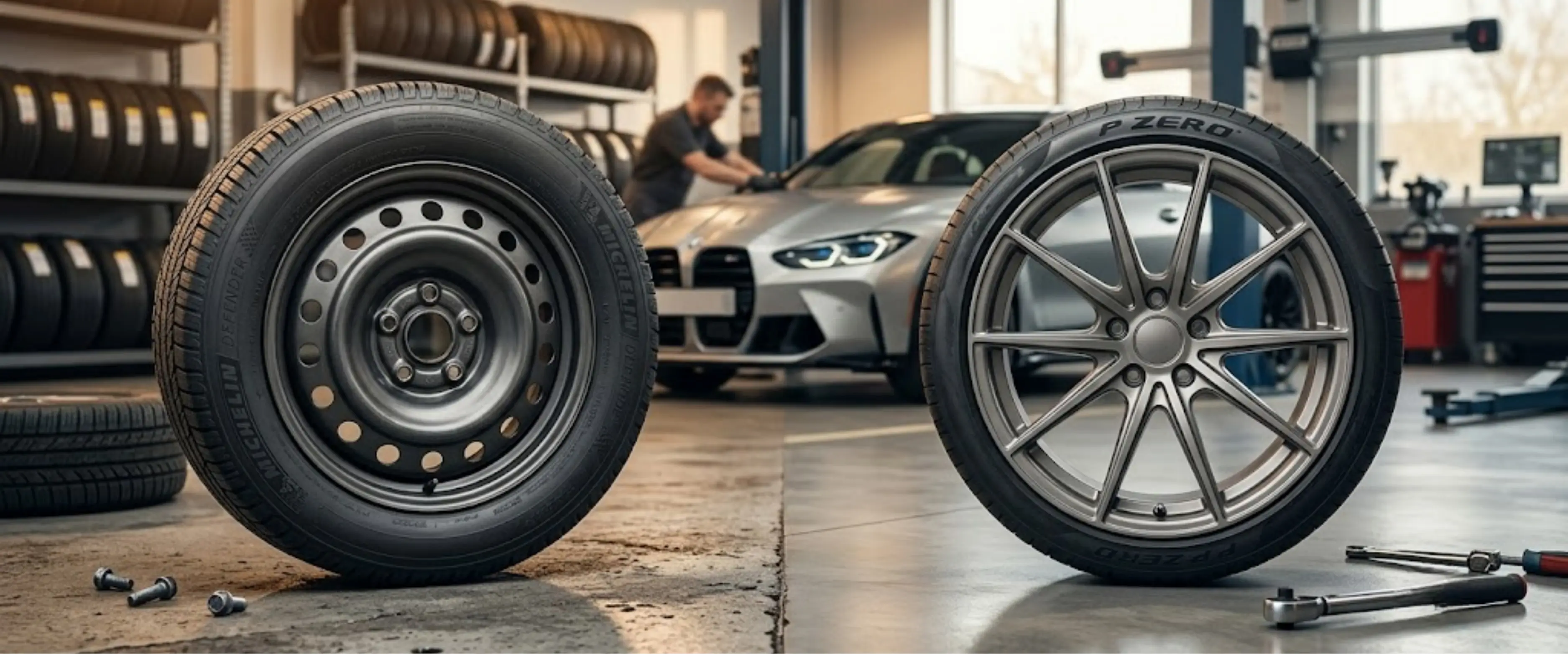
Steel wheels are made from pressed and welded sheets of steel — an alloy of iron and carbon — formed into a rim through industrial stamping and welding processes. Steel wheels are known for their low cost and affordability, durability, and versatility, making them a great choice for budget-oriented vehicles. They have been the standard fitment on mass-market cars for most of the automobile's history and continue to be the default on base variants of nearly every car sold globally.
One technical clarification that often confuses people: steel is also technically an alloy, made by mixing iron and carbon. But in the automotive world, "alloy wheels" specifically refers to wheels made from aluminium or magnesium blends. So when someone says "alloy wheels," they mean aluminium alloy wheels, not steel.
What Are Alloy Wheels?
Alloy wheels are made from a mix of metals — mostly aluminium and magnesium — that offer superior strength, corrosion resistance, lighter weight, stylish design, and are often marketed as premium features. You may have heard terms like "diamond-cut alloys" or "laser-edged alloys" in car advertisements — these refer to advanced machining and finishing processes applied to the alloy wheel's surface for an even more premium look.
Alloy wheels meet the same strength and loading requirements as steel rims at less weight. This means an alloy wheel's strength-to-weight ratio is higher than a steel wheel's. However, that doesn't make them invincible in all situations — and this nuance is exactly what most comparisons miss.
The Strength and Durability Question: The Answer Will Surprise You
This is the most misunderstood aspect of the debate. Most people assume steel = stronger. The reality is more complicated.
Steel absorbs the abuse of kerbs and potholes without failing catastrophically. Aluminium is rigid. That rigidity is great for cornering precision, but it has a downside: it is brittle.
The two materials fail in fundamentally different ways when hit hard, and this distinction matters enormously for how you manage a failure on the road.
Steel's failure mode is bending. If you hit a massive pothole with a steel wheel, it will likely bend. The tyre might hold air, and you can often hammer the rim back into shape with a mallet. In most cases, you can limp home, get it repaired cheaply, and continue on your way. You can often save a dented steel wheel by pounding it back into shape.
Alloy's failure mode is cracking. If an alloy wheel hits the same pothole, it won't bend — it will crack. A cracked rim usually leaks air immediately, leaving you stranded. Furthermore, you cannot "hammer" an alloy rim back into shape. Welding a cracked alloy wheel is possible, but it compromises the heat treatment and structural integrity. Most safety experts recommend scrapping a cracked alloy wheel.
This explains a pattern that seasoned drivers will recognise: police cruisers, taxis, and commercial vehicles use steel wheels because they jump kerbs and hit potholes daily. Steel absorbs that abuse without failing catastrophically.
Heat Dissipation and Brake Performance
This is an area where alloy wheels win clearly, and the advantage has measurable safety implications.
Your brakes work by friction, which generates massive heat. If that heat isn't dissipated, your brake fluid can boil, leading to brake fade — where the pedal goes to the floor and you don't stop. Aluminium is an excellent conductor of heat. The alloy wheel acts as a massive heat sink, pulling thermal energy away from the brake rotors and releasing it into the air.
The solid face of a steel wheel acts like a heat shield, trapping thermal energy inside the wheel well. This can lead to warped rotors and reduced braking performance in extreme conditions.
A comparative analysis of carbon steel and aluminum alloy wheel rims for the Maruti Suzuki Baleno found that aluminum alloy rims offer superior performance in terms of heat dissipation, braking efficiency, and fatigue life compared to carbon steel rims.
For most urban commuters who rarely encounter prolonged heavy braking, this difference is minimal. But for drivers in hilly terrain — the Himalayas, Western Ghats, North-East India — where long descents require sustained braking, or for drivers who regularly tow loads, the brake cooling advantage of alloy wheels is practically meaningful and contributes to safer driving.
Corrosion: A Critical Factor for Indian Conditions
India's climate creates a wide range of corrosion challenges. Coastal cities like Mumbai, Chennai, Kochi, Visakhapatnam, and Goa subject wheels to salt-laden air and high humidity year-round. Inland regions during monsoon season subject wheels to standing water, muddy roads, and sustained moisture exposure.
Alloy wheels are non-corrosive — a significant advantage for a tropical country like India, particularly in coastal areas with saline, corrosive atmospheric conditions.
Steel tells a different story. If the paint chips off a steel wheel, it will rust orange. Surface rust rarely impacts structural integrity — you can sand it and spray paint it for very little money — but persistent bead rust (at the point where the tyre rubber meets the metal) causes slow air leaks that trigger tyre pressure monitoring warnings.
Aluminium doesn't rust, but it oxidises. If the clear coat is breached by salt or curb rash, white powdery corrosion spreads under the paint like a spiderweb. This can eventually cause leaks at the tyre bead.
The net verdict on corrosion: alloy wheels are clearly superior in coastal environments, both in appearance and in preventing the kind of corrosion that leads to tyre bead leaks. Steel wheels, if their paint is maintained, are perfectly adequate in non-coastal inland environments.
The Cost Comparison: Buying, Repairing, and Replacing
This is where the gap between steel and alloy is most stark.
At the purchase level, a Hyundai i20 steel wheel costs approximately ₹1,000 each, while alloy wheels on the same car cost approximately ₹12,000 each. Aftermarket steel wheels range from ₹2,000 to ₹5,000 per wheel depending on size and brand. This is why car manufacturers offer steel wheels on base variants and alloys only on higher trims — the cost difference is built directly into the car's pricing structure.
At the repair level, the gap remains significant. A dented steel wheel can be straightened at a local workshop for a few hundred rupees. A skilled mechanic or a resourceful driver with a hammer can often beat a steel rim back into shape well enough to balance it again. A damaged alloy wheel, by contrast, may need professional refinishing at ₹1,500–₹3,000, or replacement at ₹8,000–₹25,000 per wheel for OEM units. A cracked alloy wheel, as noted above, generally needs to be scrapped entirely.
The total cost of ownership difference over the life of a car driven in rough conditions is substantial. For someone driving 15,000–20,000 km per year on Indian highways and state roads, the probability of a pothole impact severe enough to damage a wheel is not theoretical. It is a question of when, not if.
Performance for Different Driving Scenarios
City Commuting: Alloy wheels offer a meaningful advantage in urban stop-go traffic through their lighter weight, which reduces the engine load at every acceleration event. Better brake cooling helps in the slow traffic of Indian cities where brakes are used constantly. The aesthetic advantage matters more here since the car is frequently seen in stationary and slow traffic.
Highway Driving: Alloy wheels provide better handling stability at speed due to reduced unsprung weight. The fuel economy improvement, while modest (2–3%), compounds meaningfully over long-distance highway trips.
Hilly and Mountain Terrain: This is where alloy wheels earn their premium most convincingly. In hilly areas or places with lots of stop-go traffic, alloy wheels are especially helpful. In a hot country like India where brake fade can be a concern during summer or hilly drives, alloy wheels help cool down brakes faster. The thermal management advantage is not an engineering nicety here — it is a safety feature.
Rural and Off-Road Driving: Steel wins here without argument. Roads in rural India — broken tar, gravel tracks, deep potholes, unmarked speed breakers — are the conditions under which steel wheels' malleability becomes a survival advantage. When the wheel is exposed to extreme impact forces with a flat or significantly deflated tyre, alloy wheels are more likely to crack. A cracked alloy rim is almost impossible to fix on a trail and will likely need to be scrapped. In a remote location with no tyre shop for 80 kilometres, the ability to hammer a bent steel rim back into a workable shape can be the difference between a manageable inconvenience and a stranded vehicle.
Winter and Extreme Cold Conditions: For Indian drivers in the hills of Himachal Pradesh, Uttarakhand, or Kashmir, steel wheels have an additional advantage. When a rim meets an unseen pothole at sub-zero temperatures, steel tends to bend rather than crack. A shop can cold-press a dented flange for a modest sum. Aluminium becomes more brittle in cold temperatures, increasing the risk of cracking on impact. Internationally, the practice of running separate steel wheels fitted with snow tyres in winter is standard among experienced drivers precisely for this reason.
The Repair Reality: Where Steel's Advantage Is Most Practical
Let us be honest about the repair economics, because this is where theory meets the garage floor.
Steel wheel repair is a commodity service available at virtually every tyre shop and roadside mechanic in India. A bent rim can be straightened in 30 minutes for ₹200–₹500. Surface rust can be addressed with sandpaper and spray paint for ₹100. The simplicity of steel wheel repair means that across India's vast and varied geography — from a workshop in Leh to a roadside tyre shop in rural Bihar — you can get a damaged steel wheel back to functional condition.
Alloy wheel repair requires specialised equipment and skills. Diamond-cut and laser-edged alloy finishes require CNC machining to restore properly, and most small-town workshops simply don't have that capability. Alloy wheels can crack or bend upon impact. Driving on cracked alloy wheels is dangerous as the wheel may disintegrate under load. Complex repair work: alloy wheels are not as easy to repair as steel wheels.
If you drive primarily in metro areas with access to specialised wheel repair workshops, this is a manageable inconvenience. If your driving takes you through areas where the next authorised workshop is 200 kilometres away, it is a genuine risk.
The Resale Value Question
Alloy wheels do add to a car's perceived resale value. A car with alloy wheels will generally fetch a higher price than an identical car with steel wheels and hubcaps, simply because alloys signal a higher-spec variant and look more attractive to buyers. This is particularly relevant in the used car market, where visual impression drives a significant portion of buyer decisions.
However, damaged or kerb-scuffed alloy wheels can actively hurt resale value — a scratched or cracked alloy looks worse than an honest steel wheel with a hubcap. If your driving lifestyle is likely to result in cosmetic damage to alloy wheels, the resale calculation becomes murkier.
Who Should Choose What: The Definitive Decision Guide
Choose alloy wheels if:
You primarily drive in well-maintained urban and highway environments. The performance and fuel economy benefits materialise most clearly on smooth, predictable roads. You live in a coastal city like Mumbai, Chennai, Kochi, or Visakhapatnam, where the corrosion resistance of aluminium is a genuine long-term benefit. You drive in hilly terrain regularly, where alloys' superior heat dissipation protects your brakes on long descents. You care about your car's appearance and derive satisfaction from a sharp-looking set of wheels — which is a legitimate preference, not a trivial one. You have access to quality tyre and wheel repair workshops in your regular driving area.
Choose steel wheels if:
You drive regularly in Tier-2 or Tier-3 cities, rural areas, or on roads with frequent and severe potholes. The risk of a catastrophic alloy crack outweighs the aesthetic and performance benefits. You use your vehicle for utility work, hauling loads, or off-road driving where wheel impacts are frequent and high-force. You are budget-conscious and the ₹10,000–₹40,000 cost difference between steel and alloy across four wheels represents money better spent elsewhere on the vehicle or on driving experience. You drive in hilly regions with cold winters, where steel's better behaviour in low temperatures and under sudden high-impact loads is a safety consideration. You prefer simple, cheap, universally repairable wheels that can be serviced anywhere in India.
A Word on the Forgetting Factor
There is one practical reality about alloy wheels that almost never gets mentioned: they demand attention. Alloy wheels need regular cleaning to prevent brake dust from etching the finish, periodic inspection of the clear coat to catch early oxidation, careful parking to avoid kerb contact, and professional repair when damaged. High-mileage commuters do appreciate the cumulative fuel savings from alloy wheels over time, but drivers who want minimal maintenance will find steel wheels require far less attention to stay functional.
Steel wheels are genuinely low-maintenance. Paint touch-ups take ten minutes and ₹100 of spray paint. Dents can be fixed by anyone with a hammer and basic mechanical sense. Hubcaps that fall off cost a few hundred rupees to replace. For a large segment of Indian car owners who want a reliable, trouble-free vehicle that doesn't ask too much of them, steel wheels deliver exactly that.
The Verdict
The steel vs alloy question doesn't have a universal answer, and anyone who tells you it does is either selling you something or hasn't driven on enough different kinds of Indian roads.
Alloy wheels are genuinely better for performance, fuel efficiency, aesthetics, brake cooling, corrosion resistance, and the overall character of a modern car. If you drive a well-maintained car in a city or on good highways, they reward you in small but real ways every single day.
Steel wheels are genuinely better for durability in rough conditions, repairability across India's geography, cost of ownership for high-mileage utility drivers, and peace of mind when your route takes you through terrain where a cracked wheel leaves you stranded.
The practical advice: if your car came with alloys as standard, maintain them well, drive carefully over potholes, and treat them as the investment they are. If your car came with steel wheels and you're considering upgrading, be honest about your actual driving conditions before spending the money. Upgraded alloys on a car that spends half its life on broken rural roads is not a smart investment — it is an expensive mistake waiting to happen.
And if you are buying a new car: do not let the presence or absence of alloy wheels be the deciding factor in your variant choice. Engine, safety ratings, feature set, and the variant's overall value for your specific use case matter far more than the material your wheels are made from.

Rohit Sharma
AuthorLast updated 39 minutes ago