The global expansion strategy of BYD has entered a decisive phase, and Canada has emerged as a serious contender for its next manufacturing hub. As the world’s largest electric vehicle (EV) manufacturer by volume, BYD is aggressively localizing production across key international markets. With the United States becoming increasingly restrictive toward Chinese automakers, Canada is being viewed as a strategic alternative gateway into North America.
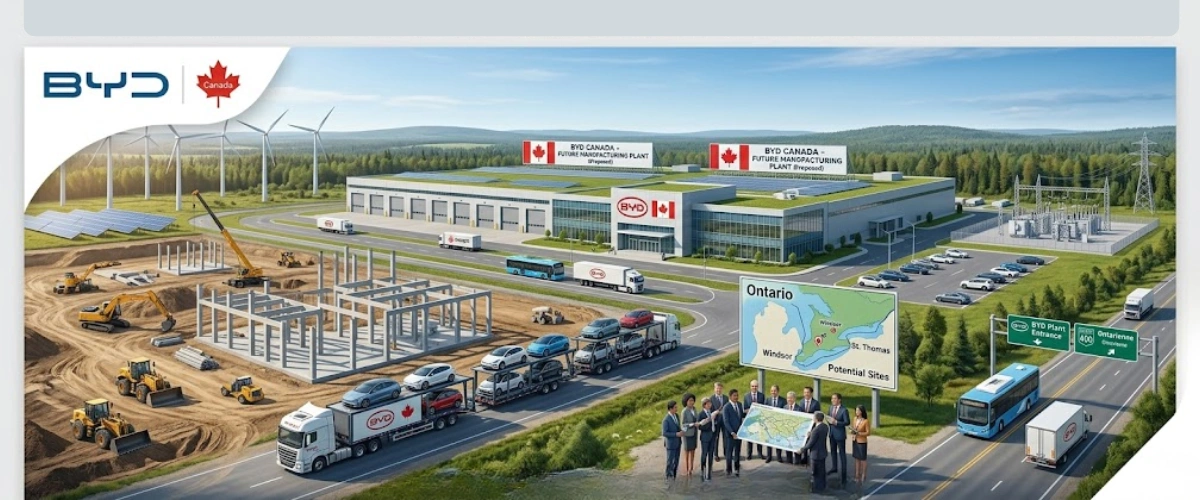
Recent developments suggest that BYD is not only planning market entry through dealerships but is also actively evaluating the feasibility of establishing a full-scale manufacturing plant in Canada. However, these plans remain at an exploratory stage, surrounded by speculation, policy complexities, and strategic uncertainty.
The Origin of the Rumors: What We Know So Far
The speculation around a Canadian plant gained traction in early 2026 when multiple reports indicated that BYD executives were assessing North American production strategies. According to industry insights, the company is evaluating whether to build a greenfield manufacturing facility or acquire an existing legacy plant.
Crucially, BYD has not made any final investment decision, and executives have emphasized that all options remain open. This ambiguity has fueled rumors, especially as the company accelerates its global manufacturing footprint across regions like Brazil, Hungary, and Turkey.
At the same time, Canada’s evolving trade stance—allowing a limited number of lower-tariff Chinese EV imports—has made the market significantly more attractive.
Strategic Context: Why Canada Makes Sense for BYD
From a strategic standpoint, Canada offers a compelling mix of industrial capability, policy support, and geographic advantage. Unlike the U.S., which has imposed strict tariffs and regulatory barriers on Chinese EVs, Canada is adopting a more flexible approach to diversify its automotive ecosystem.
One of the key drivers is North American market access. Even without direct U.S. entry, manufacturing in Canada could provide BYD with indirect leverage in the region, particularly if trade dynamics evolve over time. Additionally, Canada’s strong EV push, government incentives, and established automotive supply chains create a favorable environment for localization.
Another critical factor is resource security. Canada is rich in battery materials such as lithium, nickel, and cobalt—essential inputs for BYD’s vertically integrated manufacturing model. Establishing a plant locally would allow the company to align its production ecosystem with raw material sourcing, improving cost efficiency and supply chain resilience.
Potential Locations: Where Could BYD Build in Canada?
While BYD has not officially confirmed any specific site, industry speculation and logical analysis point toward a few high-probability regions.
Ontario: The Most Likely Candidate
Ontario stands out as the strongest contender due to its established automotive ecosystem. The province already hosts major manufacturing operations from global giants like Ford, GM, and Stellantis. More importantly, BYD already operates an electric bus assembly plant in Newmarket, Ontario, which could serve as a strategic foothold for expansion.
The presence of skilled labor, mature supplier networks, and proximity to the U.S. border makes Ontario a natural choice for a passenger EV plant. Additionally, government incentives and EV-focused policies further strengthen its appeal.
Quebec: Battery Hub Advantage
Quebec is emerging as a North American battery powerhouse, thanks to its abundant hydroelectric power and growing battery supply chain ecosystem. For a company like BYD, which emphasizes vertical integration and in-house battery production, Quebec presents a unique opportunity.
The province’s focus on clean energy aligns perfectly with BYD’s sustainability positioning. Moreover, lower electricity costs could significantly reduce production expenses, particularly for energy-intensive battery manufacturing.
Alberta or British Columbia: Long-Shot but Strategic
While less likely, provinces like Alberta and British Columbia could also enter the conversation under specific strategic scenarios. Alberta’s push toward economic diversification and British Columbia’s strong EV adoption rates make them interesting, albeit secondary, options.
However, the lack of a deeply entrenched automotive manufacturing base compared to Ontario reduces their immediate attractiveness.
Alternative Strategy: Acquisition Instead of Greenfield Investment
One of the most intriguing aspects of BYD’s Canada strategy is its openness to acquiring an existing automaker or manufacturing facility rather than building from scratch.
This approach mirrors the strategy used by other Chinese automakers, such as Geely’s acquisition of Volvo. For BYD, acquiring a legacy plant could significantly reduce time-to-market, provide instant access to skilled labor, and bypass some regulatory hurdles.
Given that several legacy automakers in North America are restructuring amid the EV transition, such opportunities may become increasingly available.
Challenges and Roadblocks: Why Nothing Is Confirmed Yet
Despite the strong strategic rationale, several challenges are slowing down decision-making.
The first is political sensitivity. Chinese investment in critical industries like automotive manufacturing often triggers scrutiny related to national security, data privacy, and economic sovereignty. Canada may be more open than the U.S., but regulatory oversight remains a key consideration.
Second is the joint venture dilemma. The Canadian government has shown a preference for partnerships between foreign automakers and local firms, whereas BYD has indicated a clear preference for wholly owned operations. This mismatch could complicate negotiations.
Third, there is market uncertainty. While EV adoption is growing, demand fluctuations, infrastructure readiness, and competition from established players like Tesla and legacy automakers add layers of risk.
Global Expansion Context: How Canada Fits into BYD’s Bigger Plan
BYD’s potential Canada move should be seen as part of a broader global expansion strategy. The company is rapidly building manufacturing bases across Asia, Europe, and Latin America to localize production and mitigate trade barriers.
For example, BYD has invested heavily in Brazil by acquiring a former Ford plant and scaling production for regional markets. Similarly, new facilities in Hungary and Turkey are aimed at strengthening its European presence.
Canada, therefore, represents the next logical step in BYD’s global footprint, especially as it seeks to establish a stronger presence in developed markets outside China.
Future Outlook: What Happens Next?
At this stage, BYD’s Canadian manufacturing plans remain speculative but highly plausible. The company is clearly laying the groundwork—through dealership expansion, policy engagement, and feasibility studies—for a deeper market entry.
Industry experts expect that a final decision will depend on three key factors:
Regulatory clarity and political acceptance
Financial incentives from provincial governments
Strategic alignment with BYD’s global supply chain
If these conditions align, Canada could soon host one of the most significant EV manufacturing investments in North America.
Conclusion: Rumor Today, Reality Tomorrow?
The rumors surrounding a BYD manufacturing plant in Canada are not baseless speculation—they are grounded in strategic logic, policy shifts, and the company’s aggressive global expansion model.
While no official confirmation has been made, the signals are clear: BYD is seriously evaluating Canada as a production hub. Whether through a new facility or acquisition, the move could reshape the competitive landscape of the North American EV market.
For now, the story remains in development—but given BYD’s pace of execution globally, this is one rumor that could turn into reality sooner than expected.

Rohit Sharma
AuthorLast updated 11 hours ago