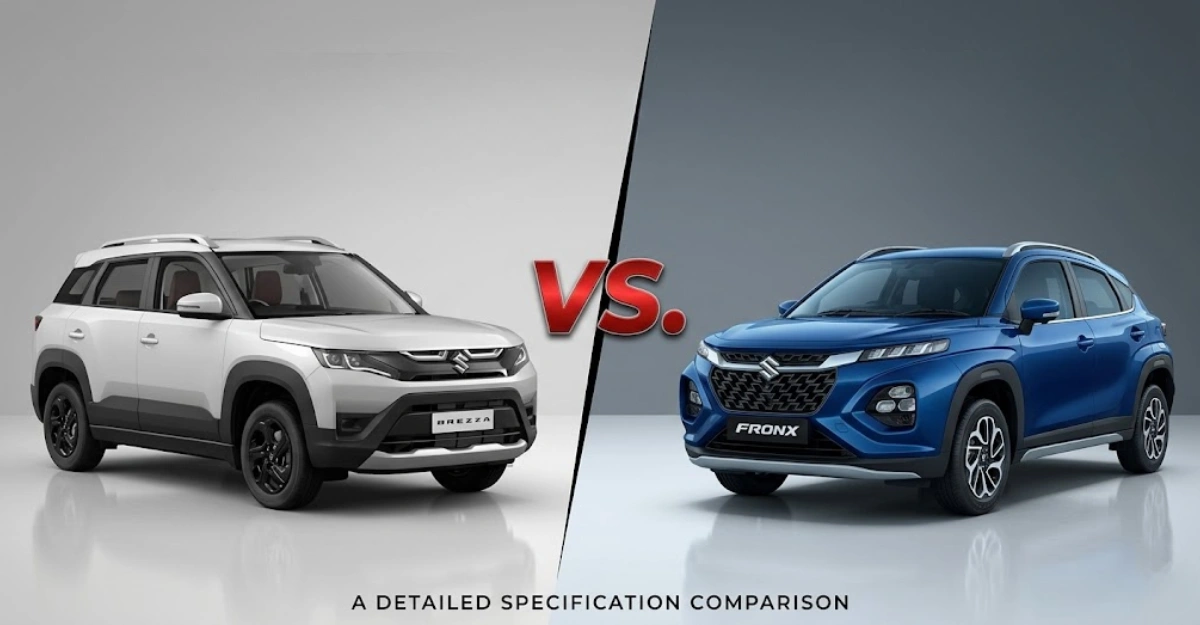
When it comes to buying a compact SUV in India, fuel efficiency is almost always the first question on a buyer's mind. Maruti Suzuki dominates this space with two very popular choices the Brezza and the Fronx. Both are sub-4-metre SUVs, both are backed by Maruti's legendary service network, and both come with petrol and CNG options. But which one is actually kinder to your wallet at the fuel pump? Let's break it down with real numbers, not just brochure figures.
Understanding the Engines First
Before comparing mileage, it is important to understand what powers each car, because the engines are fundamentally different.
The Maruti Suzuki Fronx is available in two engine options: a 1.0-litre turbo petrol (BoosterJet) producing 101 PS and 147 Nm of torque, and a 1.2-litre naturally aspirated petrol engine making 91 PS and 113 Nm. The Brezza, on the other hand, uses a 1.5-litre naturally aspirated engine producing 103 PS and 137 Nm of torque.
In simple terms, the Fronx uses smaller, lighter engines, which is a key reason it has an inherent advantage in fuel efficiency. The Brezza's 1.5-litre engine is larger, and while it provides slightly more low-end torque, it burns more fuel doing so.
ARAI Claimed Mileage: The Official Numbers
ARAI (Automotive Research Association of India) tests are conducted under controlled, laboratory conditions. These figures are the benchmark for comparison, though they rarely match real-world driving.
ARAI reported mileage for the Fronx ranges between 20 and 22.9 kmpl, while Brezza mileage falls between 17.8 and 19.9 kmpl.
Breaking this down further by variant:
For the Fronx, the ARAI-reported mileage of the 1.2-litre manual is 21.79 kmpl, while the AMT variant claims an impressive 22.89 kmpl. The 1.0-litre turbo petrol manual is rated at 21.5 kmpl.
For the Brezza, the ARAI-claimed mileage for the petrol variants is around 19.89 kmpl, while CNG Brezza variants offer a mileage of 25.51 km/kg.
On paper, the Fronx leads comfortably in the petrol category. The gap of 2–3 kmpl in ARAI figures is significant when projected over thousands of kilometres annually.
Real-World Mileage: What You Actually Get
This is where things get truly interesting — and more honest.
A difference between the claimed and practical figures exists simply because ARAI tests are conducted on a straight roller belt without the resistance of wind, potholes, or the heavy drag of city traffic.
For the Fronx in real-world conditions, in typical city traffic with stop-and-go driving, the 1.2L manual variant delivers around 13–16 kmpl. On open highways, maintaining constant speeds of around 80–100 kmph, you can realistically achieve 18–21 kmpl.
A dedicated CarWale real-world test of the Fronx 1.0-litre turbo petrol confirmed 14.25 kmpl in city conditions and 19.09 kmpl on highways.
For the Brezza, real-world tests show the Brezza petrol MT returned 10.47 kmpl in city driving and 15.89 kmpl on the highway. User-reported figures, however, paint a slightly better picture — the user-reported highway mileage for the Brezza is around 20.5 kmpl, while city mileage averages approximately 13.53 kmpl.
In real-world conditions, the Fronx consistently pulls ahead of the Brezza by approximately 2–4 kmpl in city driving and 3–4 kmpl on highways. That difference adds up quickly if you're driving 1,200–1,500 km per month, as many Indian commuters do.
The CNG Story: A Different Game
Both cars are available with factory-fitted CNG options, and this is where the running cost drops drastically.
The Suzuki Brezza has a CNG mileage of 22.1 km/kg (petrol top model equivalent), while the Suzuki Fronx claims 28.51 km/kg in its CNG variant.
For the Fronx CNG in the real world, the CNG variant promises 28.51 km/kg under ARAI conditions, but practical driving brings it closer to 25.7 km/kg.
Real Brezza CNG owners, meanwhile, report strong numbers too — CNG mileage in the city is around 25 km/kg, and on the highway it can touch 30 km/kg with smooth driving conditions.
Interestingly, in CNG mode the gap between the two narrows, and the Brezza CNG actually performs very competitively in highway conditions. However, the Fronx CNG still holds a slight edge in city driving.
Fuel Savings: A Practical Calculation
Let's put this into perspective with a practical example. Assume you drive 1,500 km per month and petrol costs around ₹105 per litre.
With the Fronx 1.2L petrol (real-world ~15 kmpl city average), monthly fuel cost ≈ ₹10,500. With the Brezza 1.5L petrol (real-world ~12 kmpl city average), monthly fuel cost ≈ ₹13,125.
That is a saving of roughly ₹2,600 per month, or over ₹31,000 per year, simply by choosing the Fronx over the Brezza for urban commuting. Over five years, the fuel savings alone could cross ₹1.5 lakh.
Why Does the Fronx Return Better Mileage?
The Fronx's fuel efficiency advantage is not accidental. Both the Fronx and Brezza offer naturally aspirated engines with mild-hybrid technology, but the Fronx's smaller engines and lighter platform give it a clear lead in fuel efficiency over the Brezza.
Additionally, the Fronx's turbo engine employs auto start/stop and brake energy regeneration to maximise economy. The Heartect platform, which the Fronx shares with the Baleno, is significantly lighter than the body-on-frame-influenced structure of the Brezza, and a lighter car always drinks less fuel.
Where the Brezza Has an Edge
Mileage is not everything. The Brezza is slightly better suited for long-distance travel because it has a bigger fuel tank and more boot space, which means fewer fuel stops on road trips. It is also taller, wider, and has more road presence — factors that matter to buyers who use their SUV for family road trips or rough terrain.
The Brezza also feels more SUV-like, with a higher seating position and a stronger sense of vehicle mass that many buyers prefer, especially on uneven Indian roads.
The Verdict: Which One Saves More Fuel?
The numbers are clear. The Fronx wins the mileage battle convincingly in petrol variants, both in ARAI-claimed figures and in real-world city and highway driving. If you are a daily commuter clocking significant kilometres in city traffic, the Fronx will save you meaningful money on fuel every single month.
The Brezza CNG, however, is surprisingly competitive and remains an excellent choice if CNG infrastructure is available in your city. For buyers who need more cabin space, a larger boot, or a proper SUV feel for highway driving, the Brezza remains a strong and well-rounded package — just not a more fuel-efficient one in petrol form.
In summary: if saving fuel is your primary goal, the Fronx is your car. If you want a fuller, more road-ready SUV and are open to CNG, the Brezza can hold its own. Either way, you are choosing from two of the most reliable, affordable-to-maintain compact SUVs available in India today — and you can't go wrong with either.

Rohit Sharma
AuthorLast updated 4 hours ago