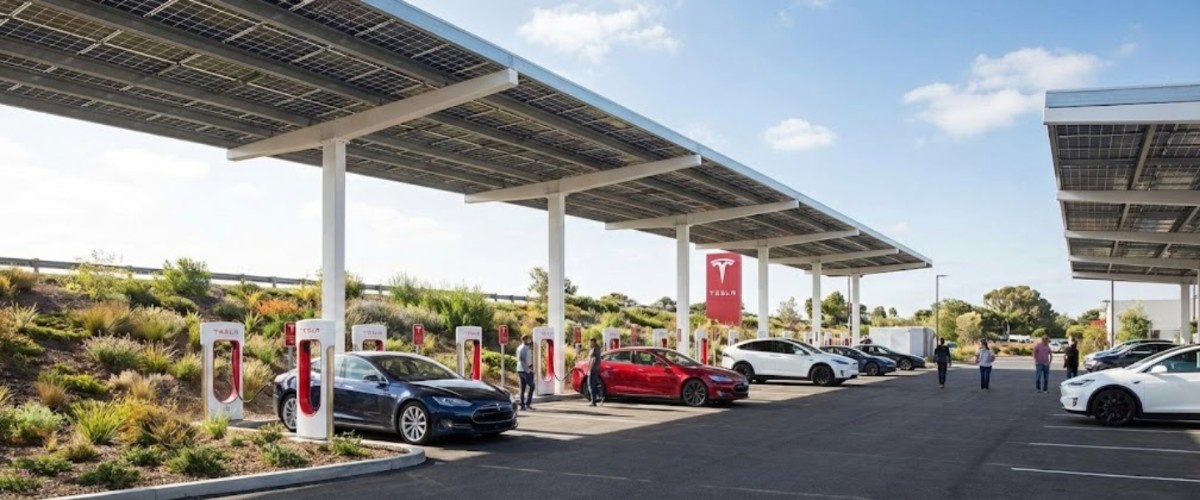
Tesla has officially taken its first major step toward India’s electric vehicle future by launching its first charging station in the country, located in Gurgaon. This development marks a significant milestone for India’s EV ecosystem and signals Tesla’s serious intent to strengthen electric mobility infrastructure in the country.
The charging station has been set up at DLF Horizon Center, Gurgaon, a premium commercial hub, making it easily accessible for EV users. With this launch, Tesla has begun laying the foundation for a reliable, fast, and global-standard charging network in India.
A Big Boost for India’s Electric Mobility Ecosystem
India’s electric vehicle market is growing rapidly, but charging infrastructure has long been a major concern for EV buyers. Tesla’s entry into charging infrastructure directly addresses this gap. By introducing its advanced supercharging technology, Tesla aims to enhance charging convenience, reduce waiting time, and improve the overall EV ownership experience.
Industry experts see this move as a strong signal that India is becoming an important market for global EV manufacturers, not just for vehicle sales but also for infrastructure development.
Four Advanced V4 Superchargers Installed
Tesla’s first charging station in India features four state-of-the-art V4 Superchargers. These chargers are among Tesla’s most advanced globally and are known for their high efficiency and ultra-fast charging capability.
Installed within the parking area of DLF Horizon Center, the chargers are designed to support smooth vehicle movement and easy access. The location choice reflects Tesla’s strategy of placing charging stations in high-footfall commercial areas where users can comfortably spend time while their vehicles charge.
Fast Charging with Up to 250 kW Power Output
One of the biggest highlights of this charging station is its fast-charging capability of up to 250 kW. This high power output allows compatible Tesla vehicles to charge much faster compared to standard public chargers currently available in India.
Fast charging is a crucial factor for EV adoption, especially for urban users and long-distance travelers. Tesla’s V4 Superchargers significantly reduce charging time, making electric vehicles more practical for everyday use.
15 Minutes of Charging for 275 km Range
According to Tesla, the superchargers installed at the Gurgaon station can charge a Tesla Model Y to deliver up to 275 kilometers of driving range in just 15 minutes. This is a game-changing capability for the Indian EV market, where charging time has often been a concern for potential buyers.
Such rapid charging not only enhances convenience but also builds confidence among users who are transitioning from traditional fuel vehicles to electric mobility.
What This Means for Tesla’s Future in India
While Tesla has not yet announced vehicle sales in India, the launch of its first charging station strongly indicates long-term plans. Establishing charging infrastructure is often the first step before introducing vehicles, as it ensures customers have reliable support from day one.
This move also sets a benchmark for other EV manufacturers, encouraging them to invest in high-quality charging networks rather than relying solely on slow or medium-speed chargers.
Impact on Indian EV Users
For Indian EV users, Tesla’s charging station brings:
-
Faster charging times
-
Global-standard charging technology
-
Improved confidence in EV infrastructure
-
Encouragement for premium EV adoption
Even non-Tesla EV manufacturers may benefit in the long run as competition drives better infrastructure and innovation.
Conclusion
Tesla’s launch of India’s first charging station in Gurgaon’s DLF Horizon Center is more than just an infrastructure update—it is a strong statement about the future of electric mobility in India. With four powerful V4 Superchargers, 250 kW fast charging, and the ability to add 275 km range in just 15 minutes, Tesla has set a new standard for EV charging in the country.
As India moves toward cleaner and smarter mobility solutions, this development marks the beginning of a new chapter—one where electric vehicles become faster, easier, and more practical for everyday use.

Rohit Sharma
AuthorLast updated 7 hours ago