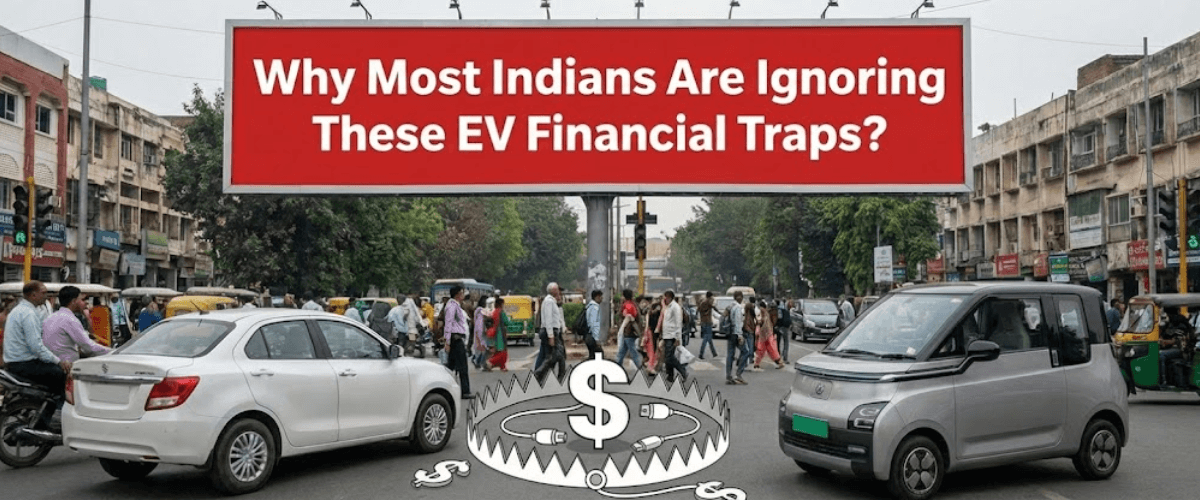
Electric Vehicles are often presented as the future of Indian mobility. From government incentives to aggressive marketing by manufacturers, EVs are positioned as cleaner, smarter, and cheaper alternatives to petrol and diesel cars. However, despite all the hype, a large section of Indian car buyers is either delaying the EV purchase decision or completely avoiding it. This hesitation is not driven by resistance to change, but by a growing awareness of hidden financial risks that are not openly discussed.
For a price-sensitive and value-driven market like India, buying a car is a long-term financial commitment. Indians tend to calculate more than just the showroom price. They carefully evaluate resale value, maintenance costs, fuel or charging expenses, and long-term reliability. When EVs are examined through this practical financial lens, several red flags begin to appear.
The High Purchase Price Still Doesn’t Make Sense for Most Families
One of the biggest reasons Indians ignore EVs is the significantly higher upfront cost. Even after government subsidies, electric cars are priced much higher than comparable petrol or diesel vehicles. For the average Indian household, paying extra lakhs upfront is a serious financial stretch.
Most buyers prefer certainty today rather than promised savings in the future. While manufacturers highlight lower running costs, Indian consumers question whether those savings will actually compensate for the higher purchase price. Factors like rising electricity tariffs, inflation, and changing policies add to this doubt. For many middle-class families, the logic remains simple: a petrol car fits the budget comfortably, while an EV introduces financial uncertainty.
Battery Replacement Anxiety Creates a Long-Term Financial Fear
Battery cost is one of the most ignored yet critical financial traps in EV ownership. The battery alone forms a major portion of the vehicle’s total price, and although brands promise long life, battery degradation over time is unavoidable.
Indian buyers worry about:
What happens after the battery warranty expires
How much replacement will cost after 6–8 years
Whether the car will remain usable for long-term ownership
Replacing an EV battery can cost several lakhs, an amount comparable to buying a small second-hand car. Since Indian car owners typically keep vehicles for 8 to 12 years, this future expense becomes a major psychological and financial burden.
Charging Is Cheaper, But Not Always Convenient or Predictable
EVs are often promoted as extremely economical to run, but this calculation assumes ideal charging conditions. In reality, many Indians live in apartments or rented houses where installing a private charging point is difficult or impossible.
Public charging infrastructure is still uneven across cities and highways. Buyers also face issues such as:
Premium pricing at fast-charging stations
Long waiting times during peak hours
Limited chargers in smaller towns
These hidden inconveniences add indirect costs, both in terms of money and time. Over the years, these factors reduce the overall value proposition of EV ownership for practical users.
Resale Value Uncertainty Makes Buyers Nervous
Resale value plays a major role in Indian car-buying decisions. Buyers expect to recover a reasonable amount when they sell or upgrade their vehicle. With EVs, resale value remains uncertain.
Second-hand buyers are often skeptical because:
Battery health is difficult to verify
There is no standardized resale valuation system
Rapid technology upgrades make older EVs feel outdated
As a result, EVs often depreciate faster than petrol or diesel cars. This creates hesitation among first-time buyers who fear being stuck with a low-value asset in the future.
EV Financing Is Still Not Buyer-Friendly
Car loans are essential for most Indian buyers, but EV financing has not matured yet. Many banks and lenders consider EVs higher-risk due to uncertain depreciation and evolving technology.
Common financing challenges include:
Lower loan-to-value ratios
Higher interest rates
Shorter loan tenures
When buyers compare monthly EMIs, EVs often appear more expensive than petrol cars, even before accounting for charging and maintenance. This discourages many financially cautious customers early in the decision-making process.
Psychological Cost and Risk Perception Matter More Than Advertised Savings
Beyond financial calculations, Indian buyers are heavily influenced by risk perception. EVs are still seen as new and rapidly changing technology. Buyers worry that newer models with better range and features may arrive quickly, making their vehicle outdated.
There is also concern about:
Range anxiety during long drives
Charging availability in emergencies
Reliability in remote or rural areas
Even when long-term savings look attractive on paper, the fear of unexpected expenses pushes buyers toward petrol or diesel vehicles that feel familiar, reliable, and predictable.
Conclusion: Awareness Is Driving Caution, Not Resistance
Most Indians are not ignoring EVs because they oppose electric mobility. They are cautious because they see unresolved financial risks. High upfront costs, battery replacement fears, unclear resale value, charging challenges, and unfavourable financing terms together create the perception that EV ownership is still financially risky for the average Indian household.
Electric vehicles will undoubtedly play an important role in India’s automotive future. However, mass adoption will happen only when these financial traps are addressed transparently. Until then, Indian buyers will continue to prioritize practicality over promises, waiting for EVs to become not only environmentally responsible, but financially reassuring as well.
FAQs: Why Most Indians Are Ignoring EV Financial Traps
1. Why are EVs still considered expensive in India?
EVs have a higher upfront cost than petrol cars due to expensive batteries and imported components.
2. Are electric vehicles really cheaper to run in India?
Yes, but only when home charging is available and electricity costs remain stable.
3. What is the biggest financial risk of owning an EV in India?
Battery replacement cost after warranty expiry is the biggest long-term financial risk.
4. How long do EV batteries usually last in Indian conditions?
Most EV batteries last around 6–8 years, depending on usage and charging habits.
5. Why is EV resale value uncertain in India?
Lack of standard battery health certification and rapid technology changes reduce buyer confidence.
6. Is financing an electric car difficult in India?
Yes, EV loans often have higher interest rates and lower loan coverage than petrol cars.

Rohit Sharma
AuthorLast updated 1 day ago