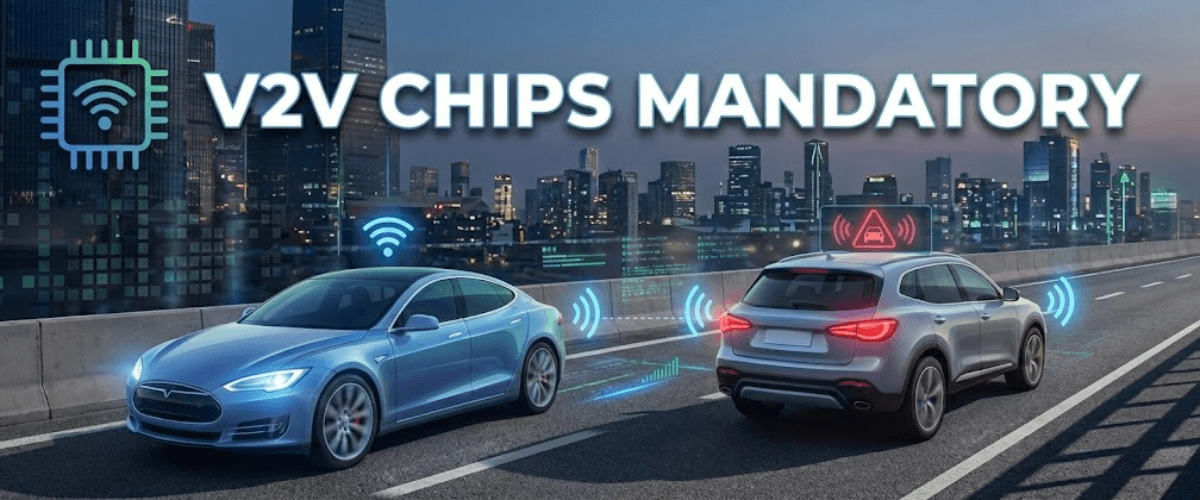
Road safety in India is about to take a big technological leap. By the end of 2026, new vehicles in India may come with mandatory V2V (Vehicle-to-Vehicle) communication chips. This means cars, buses, and trucks will be able to talk to each other wirelessly and warn drivers about possible dangers on the road before they can even see them.
This important announcement was made by Union Road Transport and Highways Minister Nitin Gadkari. The main goal behind this move is simple but powerful — to reduce road accidents and save lives. The government aims to cut road accident deaths by 50% by 2030.
Let’s understand what V2V technology is, how it works, its benefits, cost impact, and the challenges ahead — in simple words.
What Is V2V (Vehicle-to-Vehicle) Communication Technology?
V2V technology allows vehicles to share information with nearby vehicles automatically using wireless signals. Instead of depending only on the driver’s eyes or car cameras, vehicles will exchange safety-related data like:
Speed
Location
Direction
Sudden braking alerts
This information is shared in real time, helping drivers react faster and avoid accidents.
In short, vehicles will warn each other about danger, just like pilots communicate with each other in the sky.
Why Is the Government Making V2V Mandatory?
India records one of the highest numbers of road accidents in the world. Many accidents happen due to:
Poor visibility (fog, rain, night driving)
Blind turns and intersections
Sudden braking
Stationary vehicles on highways
Cameras and sensors alone are not enough in such situations. V2V technology works even when visibility is poor, making it a powerful safety tool.
After discussions with transport ministers from 28 states and Union Territories, the government decided to move ahead with this plan.
How Will V2V Technology Work in Vehicles?
Every new vehicle will be fitted with a small device called an On-Board Unit (OBU).
Role of the On-Board Unit (OBU)
The OBU will continuously send and receive signals from nearby vehicles
It will share information like speed, braking status, and direction
If a nearby vehicle brakes suddenly or stops, your car will get an alert
The driver will receive warnings before a dangerous situation occurs
This communication happens wirelessly, without internet or mobile networks.
Where Will V2V Be Most Useful?
V2V technology will be especially helpful in situations where human eyes, cameras, or radars fail.
1. Fog and Low Visibility
Even in heavy fog or rain, vehicles behind will know if the vehicle ahead has slowed down or stopped suddenly.
2. Blind Turns and Intersections
At sharp turns or crossroads where you cannot see oncoming traffic, V2V will alert you in advance.
3. Stationary or Broken Vehicles
If a vehicle is stopped due to breakdown or accident, approaching vehicles will get early warnings.
4. Highways and Expressways
Helps reduce high-speed collisions by giving drivers extra reaction time.
How Is V2V Different from ADAS?
Many modern cars already come with ADAS (Advanced Driver Assistance Systems), but V2V is very different.
Example:
If a truck is driving in front of your car and there is danger ahead of the truck, ADAS cannot see it. But with V2V, the vehicle ahead can send a warning signal that reaches your car through the truck.
How Much Will V2V Increase Vehicle Prices?
The government may spend around ₹5,000 crore on this entire program.
For customers:
The On-Board Unit (OBU) may cost around ₹5,000 to ₹7,000 per vehicle
This could slightly increase vehicle prices
Who Will It Apply To First?
Initially, new cars, buses, and trucks
Later, rules may allow retrofit installation in older vehicles
Experts believe the safety benefits are far more valuable than the small price increase.
Spectrum Allocation and Government Planning
For V2V communication to work smoothly and reliably, vehicles need a dedicated radio frequency band. To make this possible, the government has formed a joint task force with the Department of Telecommunications (DoT). The DoT has agreed in principle to allocate 30 MHz spectrum in the 5.875–5.905 GHz band specifically for V2V technology. At the same time, the government is working closely with automobile manufacturers to finalize common technical standards. This is an important step because it will ensure that vehicles from different brands can communicate with each other without any compatibility issues, making the system safe, reliable, and effective on Indian roads.
Challenges in Implementing V2V by 2026
While the plan is ambitious, it comes with challenges.
1. Global Experience
Countries like the USA, Europe, and Japan allocated spectrum years ago, yet full implementation is still ongoing.
2. Auto Industry Readiness
Car manufacturers need time for:
Hardware integration
Testing across models
Compatibility between brands
3. Infrastructure & Awareness
Drivers also need awareness and training to understand and trust alerts.
Despite these hurdles, India is pushing hard to meet the 2026 deadline.
What This Means for Indian Car Buyers
By late 2026 and beyond:
New vehicles will be much safer
Accidents caused by human error can reduce significantly
Indian roads will slowly move toward connected and intelligent mobility
This technology is a step toward smart roads and autonomous-ready vehicles in the future.
Conclusion
The decision to make V2V chips mandatory in new vehicles by late 2026 is a landmark move for road safety in India. By allowing vehicles to communicate with each other, the government aims to reduce accidents, improve driver response time, and save thousands of lives every year.
Though there may be a small increase in vehicle prices, the long-term benefits in terms of safety, confidence, and accident prevention are far greater. If implemented successfully, V2V technology could change the way we drive on Indian roads forever.
FAQs – V2V Technology in Vehicles
Q1. What is V2V technology in vehicles?
V2V is a system that allows vehicles to wirelessly communicate with each other to share safety alerts.
Q2. When will V2V chips become mandatory in India?
The government plans to make V2V chips mandatory in new vehicles by the end of 2026.
Q3. How does V2V help reduce accidents?
It warns drivers about nearby vehicles, sudden braking, blind turns, and low-visibility dangers in advance.
Q4. Will V2V work in fog and at night?
Yes, V2V works through wireless signals and does not depend on visibility.
Q5. Is V2V better than ADAS?
V2V complements ADAS by sharing information beyond camera and sensor range.
Q6. How much will V2V increase vehicle prices?
Vehicle prices may increase by around ₹5,000 to ₹7,000 due to the onboard unit.

Rohit Sharma
AuthorLast updated 1 day ago