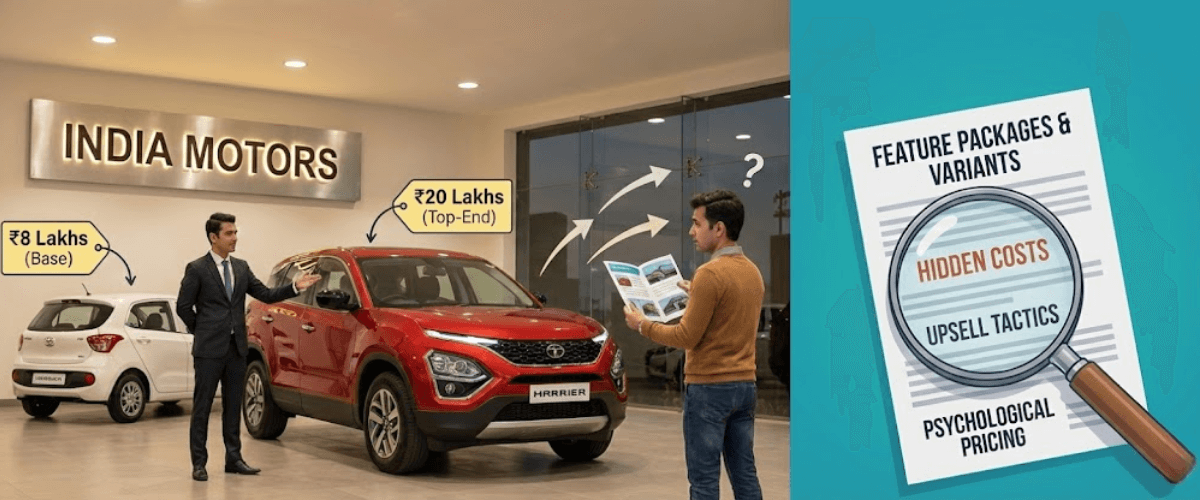
Buying a car in India is no longer just about choosing a model. It has become a carefully designed journey where car brands subtly push buyers toward higher and more expensive variants. While brochures highlight “options” and “freedom of choice,” the reality is that many buyers end up paying far more than planned — often without realizing how or why.
Indian car buyers are highly value-conscious, yet manufacturers understand emotions, aspirations, and psychology very well. Through strategic feature placement, clever pricing, and showroom tactics, brands make base variants look inadequate and top variants feel irresistible. Let’s break down how this happens and why so many buyers fall into this trap.
The Base Variant Is Intentionally Made Unattractive
Most car buyers start with a fixed budget and naturally look at the base or mid variants. However, manufacturers often design base variants to feel incomplete. Essential features that buyers now consider “basic” are deliberately excluded.
Commonly missing features in base variants include:
Touchscreen infotainment systems
Alloy wheels
Rear power windows
Adjustable headrests
Basic safety or convenience features
When buyers see these omissions, the base variant immediately feels outdated or compromised. The idea is not to sell the base model in high numbers, but to use it as a price anchor that makes higher variants look more appealing.
Feature Gaps Force You to Jump Variants
Instead of evenly distributing features across variants, brands create sharp feature gaps. A single desirable feature is often bundled with many unnecessary or premium features, forcing buyers to upgrade more than they intended.
For example, a buyer may only want:
A touchscreen
Automatic climate control
Rear camera
But these features are available only in a much higher variant, along with sunroof, bigger alloys, or cosmetic upgrades. This “all-or-nothing” packaging pushes buyers to stretch their budget unnecessarily.
Psychological Pricing Makes Higher Variants Look Cheap
One of the most powerful tricks used by car brands is psychological pricing. The price difference between variants is carefully calculated to feel “reasonable” at each step.
Buyers often think:
“If I’m already spending this much, why not add a little more?”
“The top variant is just slightly more expensive.”
In reality, these small jumps can add up to lakhs by the time you reach the top variant. The gradual price climb masks the total overspend, making premium variants feel like better value even when they exceed the original budget.
Showroom Experience Is Designed to Influence Your Choice
Most showroom cars on display are mid or top variants. Sales executives rarely promote base variants enthusiastically because their commission and targets often favor higher trims.
During showroom visits:
Test drive vehicles are usually top variants
Features of higher trims are heavily emphasized
Limitations of lower variants are exaggerated
By the time a buyer sits inside a well-equipped variant, going back to a simpler version feels like a compromise. This emotional attachment plays a major role in pushing buyers upward.
Safety Features Are Used as Emotional Leverage
Safety should be standard across all variants, but in India, it is often used as a premium selling tool. Important safety features are sometimes reserved for higher trims.
Features like:
Side and curtain airbags
Electronic stability control
Advanced braking assistance
are marketed as “premium safety,” subtly implying that lower variants are less safe. Buyers, especially families, are emotionally pressured into choosing expensive variants in the name of safety.
Cosmetic Upgrades Are Overvalued
Many higher variants charge a premium for features that add visual appeal but limited real-world value. These include chrome accents, larger alloy wheels, ambient lighting, and dual-tone interiors.
While these upgrades look attractive in showrooms and advertisements, they do not significantly improve driving comfort, safety, or reliability. Yet buyers often pay heavily for them because they influence social perception and resale appeal.
Automatic Transmissions Are Used as a Pricing Trap
Automatic gearboxes are increasingly popular, especially in cities. Brands often restrict automatic options to higher variants only.
This forces buyers into:
Expensive trims they may not need
Additional cosmetic and feature bundles
As a result, the cost of convenience rises sharply, even though the buyer’s primary requirement was just an automatic transmission.
Limited Editions and “Value” Packs Create Urgency
Car manufacturers frequently introduce limited editions or special variants with minimal additions but higher pricing. These variants are marketed as “exclusive” or “best value.”
Buyers fear missing out and assume they are getting more for their money. In reality, these editions often add accessories that could be installed aftermarket at a much lower cost.
Conclusion: Awareness Is Your Best Defense
Car brands in India are not necessarily dishonest, but they are highly strategic. Their goal is to maximize revenue per customer, and variant structuring is one of the most effective tools to achieve this.
To avoid falling into the expensive-variant trap:
Focus on needs, not features
Set a strict budget before entering the showroom
Compare variant-wise price jumps carefully
Evaluate whether features justify the extra cost
A well-informed buyer can save lakhs by choosing the right variant instead of the most advertised one. In today’s market, awareness is not just power — it’s money saved.
FAQs: How Car Brands Push Buyers Toward Expensive Variants
1. Why do car companies in India price base variants so low?
Base variants act as price anchors to attract buyers and push them toward higher trims.
2. Why are important features missing in base variants?
Manufacturers intentionally remove popular features to make higher variants feel necessary.
3. How do feature bundles force buyers to upgrade?
Essential features are grouped with premium ones, leaving no affordable middle option.
4. Why do higher variants seem “better value” in showrooms?
Psychological pricing makes the price jump appear small compared to the added features.
5. Do sales executives influence variant selection?
Yes, they usually promote higher variants due to better commissions and targets.
6. Why are safety features not standard across all variants?
Safety is often used as an upselling tool to justify higher variant pricing.

Rohit Sharma
AuthorLast updated 53 minutes ago